

Quietly hyperbolic
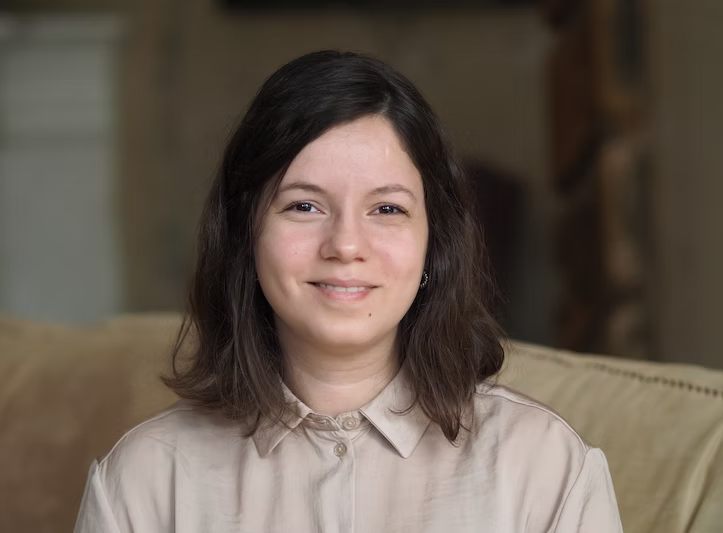
The story of Daina Taimiņa, a hidden figure who made an impossible shape visible
Unfold
I’ve always been fascinated by mathematics. It was one of my favorite subjects in school, along with physics. Maybe that has something to do with the teachers I was lucky to have, they were some of the most passionate and encouraging people I’ve met. And today I see that, coincidently or not, they were great communicators.
One day, my high school math teacher told us about the fourth dimension, while drawing along on the white board. “How do you jump from one dimension to the other? Start with a line segment, one dimension. Hold one of the extremities and fold it, and you get a plane, a two-dimensional object. Do the same again, and you get a cube, a three-dimensional object. To reach the fourth dimension? Imagine doing the same, but starting with a cube.” Two decades later, I still remember how my mind was blown.
One of the things that fascinated me about mathematics is that it’s full of concepts that feel removed from our everyday reality, like a strange and complex parallel universe. But with a bit of cleverness and imagination, it becomes surprisingly visual, like my teacher showed with his drawing. And people who make these abstract worlds visible are everywhere, even if they often remain unnoticed.

Break
To tell this story properly, we need to step back some millenia and start with Euclid in Ancient Greece. Back in a day where geometry was very hands-on, for example to build great architectural wonders and navigate in unknown seas, Euclid had the very scientific urge to organize what was known onto paper (or rather, papyrus). His publication, dating from 300 BC, has five famous postulates that laid the foundation for geometry as most of us non-mathematicians know it.

Euclid’s work stood strong until the 19th century, when a breakthrough emerged: two mathematicians working independently, János Bolyai in Hungary and Nikolai Lobachevsky in Russia, showed that one of Euclid’s postulates could be replaced by an alternative that was equally valid. The postulate in question states that if a line intersects two others and the interior angles on the same side sum to less than 180 degrees, those two lines will eventually meet on that side when extended. By demonstrating that this rule does not always hold, they opened the door to entirely new geometries in what is now called non-Euclidean space.

Among these new geometries was the hyperbolic plane, a surface with constant negative curvature. And what is that? Following my school teacher’s approach, it helps to start from something familiar: a sphere. If you hold one in your hands, you can feel that its surface curves the same way in every direction, which is what mathematicians call constant positive curvature. A hyperbolic plane, by contrast, curves in the opposite way. Something like a saddle that bends up in one direction and down in another, extending outward indefinitely.

The discovery of this “impossible” geometry fundamentally changed how humankind understands space. But there was a problem: although mathematicians could describe hyperbolic space with equations, they struggled to visualize it. For decades, it remained something that lived on paper and in one’s imagination.
Connect
This is where Daina Taimiņa enters the room. Hers is not a name most people recognize, and yet her work changed how generations understand an entire branch of geometry.
Born and raised in Latvia, some 2,300 years after Euclid’s world-changing publication and 200 years after the discovery of hyperbolic geometry, she was likely another little girl fascinated by mathematics in school who, luckily for science, went on to pursue it as a career. Taimiņa studied at the University of Latvia, later earning a doctoral degree and teaching there before joining Cornell University in the United States, where she taught until retiring in 2013.
Early in her Cornell days, in 1997, Taimiņa attended a workshop for university professors led by geometer David Henderson. There, she encountered a fragile paper model of the hyperbolic plane, one that was difficult to handle and far from ideal for teaching. Faced with the challenge of helping her students grasp this abstract concept, she looked for a better way to represent it. And having grown up knitting and crocheting, the idea emerged: what if the geometry could be built with yarn? By increasing the number of stitches in each row, the fabric would expand exponentially, mirroring the indefinite extension of hyperbolic space.

See
Taimiņa’s idea was a big success. Using crochet, she created models of the hyperbolic plane that were flexible, durable, and, most importantly, tangible. For the first time, students could hold hyperbolic space in their hands without it falling apart. They could stretch it, turn it, explore it. A concept that had remained abstract and difficult to represent physically for decades suddenly became something one could see and touch.
And the interesting thing about making complex science visible is that, once you’ve seen it, you start recognizing it everywhere. The hyperbolic plane is in coral reefs, in sea slugs, in the frilled edges of lettuce leaves. Nature, it turns out, has been “crocheting” hyperbolic geometry all along. The indirect impact of this act of translation, helping us understand our world and inspiring others to do the same, is immense. And yet, the person who helped us recognize these patterns remains largely unknown outside specialist circles.
Today, Taimiņa is enjoying her retirement and still involved in creative projects, including Mathemalchemy, a traveling art installation in the United States ran by a group of bright mathematicians. A good reminder that she’s not alone in trying to bring hidden worlds within reach.
As we celebrate the people who discover new things, let’s not forget those who make these discoveries visible and accessible to others. Because without them, entire worlds would remain hidden in equations and abstractions. May the story of Daina Taimiņa remind us that making knowledge visible is a fundamental part of how science moves forward.


References
Daubechies, Ingrid (2024). Mathemalchemy: What Is It, and How Did It Start? Juniata Voices, 23, 33–43. https://journals.juniata.edu/index.php/jcv/article/view/21
Taimiņa, Daina (2009), Crocheting Adventures with Hyperbolic Planes, 2nd edition. Natick, Massachusetts, A.K Peters.
Thorgeirsson, Sverrir (2014), Hyperbolic Geometry: History, Models, and Axioms. https://uu.diva-portal.org/smash/get/diva2:729893/FULLTEXT01.pdf
Wertheim, Margaret (2005). Crocheting the Hyperbolic Plane: An Interview with David Henderson and Daina Taimina. https://www.cabinetmagazine.org/issues/16/wertheim_henderson_taimina.php


Comments