

A Belgian (hi)story \ How George Sarton started mapping the history of science in Wondelgem

In Wondelgem, just outside Ghent, people now push shopping carts through the aisles of a Colruyt supermarket. There is nothing there to suggest that, a little over a century ago, this was the site of an intellectual project that would go on to shape an entire field. In 1912, the first edition of the scientific journal Isis was compiled here, in the home of the Sarton family.
Seeds in Wondelgem
George Sarton was not yet the “father of the history of science.” At the time, the field he would later define barely existed. Scientists wrote science. Historians wrote history. The idea that science itself had a history worth studying, systematically, rigorously, and across cultures, was not yet commonplace, but Sarton wanted to change that.
He did not arrive at that ambition through a straight path. Born in Ghent on August 31st of 1884, George Sarton lost his mother when he was still an infant and was raised largely under the influence of his father, Alfred Sarton, a chief engineer and director in the Belgian national railway system. The young George Sarton went to the athénée in Ghent and spent four years as a boarder at the Athénée of Chimay. He initially enrolled in philosophy at the University of Ghent, but abandoned it after two years, dissatisfied with what he saw as the field’s distance from the rapidly changing scientific world. He turned instead to the natural sciences, studying chemistry, mathematics, and celestial mechanics, and completed a PhD in 1911 with a dissertation on Newtonian mechanics. But even that did not feel sufficient. Science, he came to believe, could not be fully understood without understanding its history, and that history, in turn, required both scientific and humanistic insight.
At the time, Sarton was not yet an established academic with a secure institutional position. What he had instead was a conviction and, crucially, the means to act on it. After his father’s death in 1909, he sold the family wine cellar at auction and used the proceeds to buy a house in Wondelgem, where he and his new wife, the English artist Mabel Elwes, settled in 1912.
There, he began working on a journal that would serve as the foundation for his grand ambition. He called it Isis, after the Egyptian goddess associated with knowledge, nature, and the unveiling of hidden truths, a fitting name for a project concerned with uncovering how human understanding takes shape over time.
It was, from the start, an unlikely endeavor: international in scope, interdisciplinary in intent, and launched without institutional backing. Sarton financed the journal largely himself, using the money from his inheritance. Yet the first issue already bore the marks of the global enterprise he had in mind. Alongside his Belgian address, the title pages listed collaborators and supporters across an extensive international network, from Brussels, to Paris, Vienna, Prague, Berlin, and all the way to New York, Mexico City, and even Calcutta.
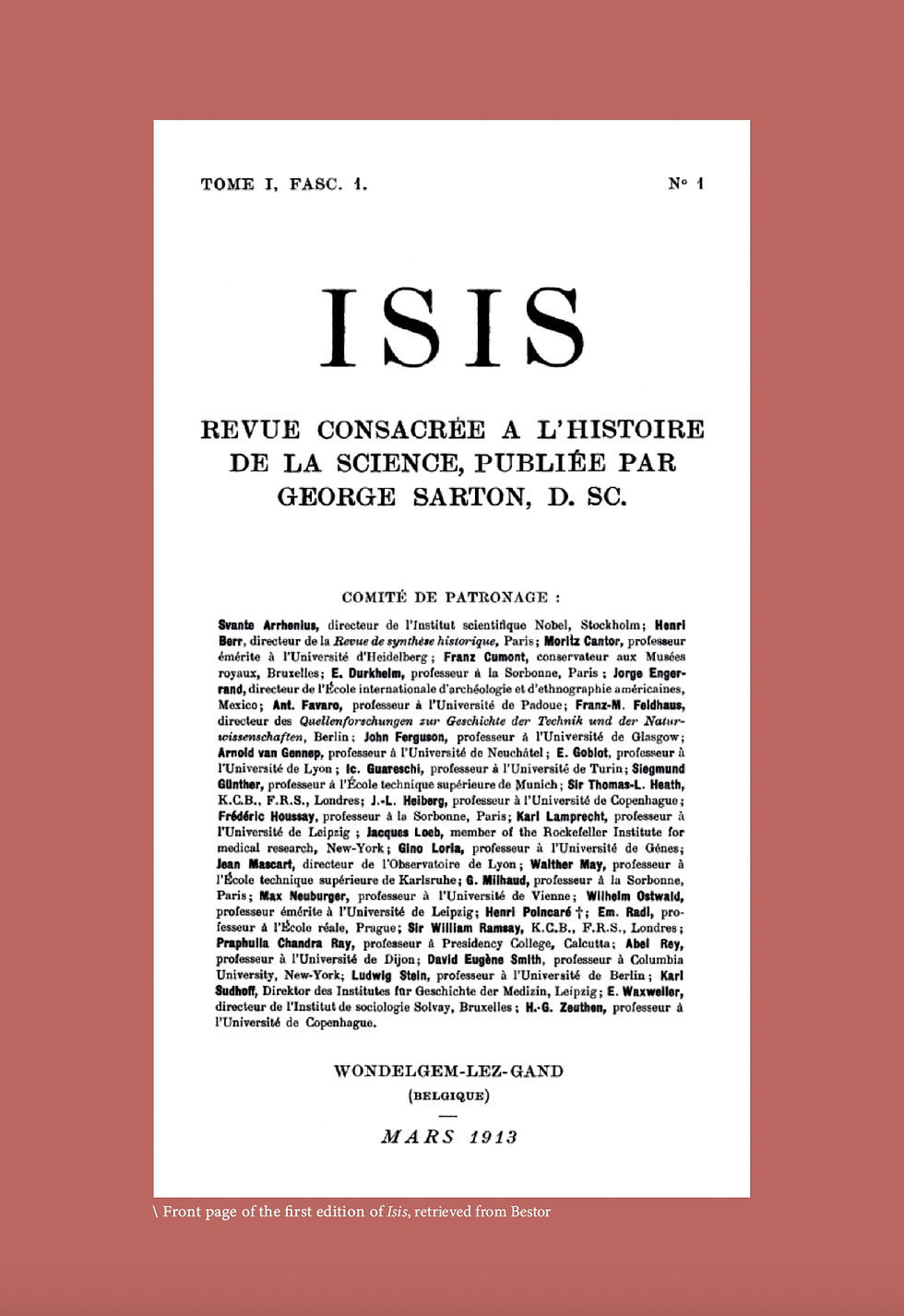
Sarton’s wife played a crucial role in shaping the journal in its earliest years. She contributed not only practical support but also editorial and visual input. In that same year, the household expanded in another way: George and Mabel’s daughter May was born.
Sarton would later remark that in 1912 he had been given two children: his daughter, and Isis.
Then came the war.
Exile in the US
In 1914, the German invasion of Belgium brought the Sartons’ life in Wondelgem to an abrupt end. Sarton continued working for a few months, but in November the German army commandeered the house. Before leaving, he buried part of his notes in the garden. The family fled, first to the Netherlands, then to England.
In April 1915, Sarton sailed for New York. Mabel and their daughter May followed later, once he had secured a first academic foothold. After early teaching appointments in Illinois and at the Carnegie Foundation, Sarton arrived at Harvard in 1916. There, through courses and public lectures, he gradually built an audience for the history of science as a field in its own right.

In the US, Sarton also resumed work on Isis, which had been interrupted by the war. The journal remained precarious. For many years, he paid its annual deficit out of his own salary, sometimes as much as 800 dollars. That this was possible at all owed much to Mabel, who supplemented the family income through her work as a designer and teacher.
Despite these constraints, the journal steadily gained ground. It became a meeting place for scholars scattered across disciplines and countries, and a vehicle through which Sarton could articulate his vision of the field. Around it, more formal structures began to emerge. In 1924, the History of Science Society was founded, in part to support Isis, which became its official journal. Later, Osiris was established to accommodate longer and more thematic studies. Sarton’s personal initiative gradually took on institutional form.
From the outset, he had been explicit about what he was trying to do. In an early statement of purpose, Sarton wrote: “History, for us, is only a means, an indispensable instrument... The end is the philosophy of science; the end is to acquire a more perfect knowledge of nature and of man.”
As knowledge expanded and disciplines became increasingly specialized, Sarton warned of a growing fragmentation: sciences advancing rapidly, but often in isolation from one another, and from the wider intellectual life to which they belonged. The analytical power of modern science, he noted, came at a cost, breaking problems into ever smaller parts, while risking the loss of a coherent view of the whole.
For Sarton, the history of science offered a way to counter that fragmentation. It reconnected scientific developments to their philosophical implications and to the broader human context in which they emerged. Against both the positivist tendency to grant science an exclusive authority over our understanding of the world, and the opposing reaction that sought to diminish it in favor of intuition or purely humanistic approaches, Sarton argued for a more integrated perspective, one in which scientific and humanistic forms of knowledge informed one another.
That ambition also shaped the scale and style of his work. He was not interested in isolated episodes or neatly bounded case studies so much as in the larger structure of human knowledge: how ideas moved, how disciplines intersected, and how scientific developments related to wider currents in civilization. To explain that method, he reached for a striking metaphor:
“Perhaps the briefest way of intimating [my] general method is to compare my activity with that of a mapmaker. Though I have taken considerable pains to ensure the accuracy of every detail, however small, my main interest is not in any of them, however important, but in the whole structure. Even as the cartographer’s purpose is to evidence the relations of the geographical facts, my main purpose has been to show the relations of the historical facts. [...] I have tried to draw a map [...] which would be as complete and accurate as possible, and yet simple enough, sufficiently free from unessential details, sufficiently condensed, not to obstruct the general view.”
Germination anywhere
On March 22, 1956, Sarton died suddenly, at the age of 71.
Over time, Isis grew into what it remains today: one of the central journals in the history of science. It publishes research articles, critical reviews, and historiographical reflections, bringing together scholars from across the world.
And yet, the origins of that institution are easy to overlook.
Sarton himself has not been entirely forgotten. His name lives on in medals, institutes, and academic references. But outside specialist circles, he is far less visible. Would anyone shopping in that Colruyt in Wondelgem have ever heard of his existence?
Sarton, however, cared deeply about how history is told and about what gets left out. He was openly critical of those who, in his view, distorted the history of science through omission or careless simplification. What others might have seen as harmless narrative choices, he regarded as something more serious.
Former Harvard President James B. Conant wrote: “I recall more than one conversation and several exchanges of letters in which the historian and scholar [Sarton] poured forth his scorn upon those popularizers of science who by sins of omission or commission falsified history... and of how great was his contempt for simplifications that bordered on dishonest writing.”
For Sarton, the danger was not only in getting the facts wrong, but in telling a story that was too clean. To remove complexity was to misrepresent the nature of scientific work itself, its uncertainty, its collective character, its dependence on context. Science communicators, take note.
That is one reason Sarton feels like such a fitting figure for this edition of Big Bang. For him, the history of science was never just about science itself, in the narrow sense of theories or discoveries. He was deeply interested in the people behind that knowledge: not only the celebrated figures, but also the many lesser-known contributors who collected, translated, preserved, and transmitted ideas across time and cultures. In his own work, he moved deliberately between the famous and the forgotten, treating both as part of the same continuous story.
With science being a cumulative enterprise, its history cannot be reduced to a handful of great names. It has to account for the many individuals whose contributions made that continuity possible, even if their names rarely endured. It is a perspective that resonates with any attempt to look beyond the usual names and ask how scientific memory is made—and unmade. An effort we are focusing on in this Big Bang edition’s theme.
Back in Wondelgem, there is no trace of where it began. No plaque marks the house where Sarton and Mabel assembled the first issue of Isis. No sign indicates what started there. “At the end of his life,” Harvard University president James B. Conant wrote, “Sarton could look back and take pride in the increasing interest, in the United States, in the cause which he had so vigorously promoted for so many years.” He was reminded by what Sarton himself had written to him many years before his death:
“I console myself with the thought that intellectual seeds have this advantage over material ones, that they can germinate anywhere (if at all), not only in the place where they are sown.”
References
I first came across Sarton’s story not through a history textbook, but via an article in Eos by Maarten Langhendries. He references Bestor, the Belgian Science and Technology Online Resources platform—another gem, I am ashamed to admit, I did not know. Bestor is part of an ongoing effort to bring the history and philosophy of science closer to broader audiences, continuing, in a different form, the kind of connective work Sarton once pursued through Isis.
This text is based on the following rich first-person accounts about the life and works of George Sarton:
Cohen, B.I. “George Sarton.” Isis 48, no. 3 (1957): 286–300. http://www.jstor.org/stable/226466.
Conant, J.B. “George Sarton and Harvard University.” Isis 48, no. 3 (1957): 301–5. http://www.jstor.org/stable/226467.
Singer, D. & Singer, C. “George Sarton and the History of Science.” Isis 48, no. 3 (1957): 306–10. http://www.jstor.org/stable/226468.
Thackray, A., & Merton, R.K. “On Discipline Building: The Paradoxes of George Sarton.” Isis 63, no. 4 (1972): 473–95. http://www.jstor.org/stable/229772.
Merton, R.K. “George Sarton: Episodic Recollections by an Unruly Apprentice.” Isis 76, no. 4 (1985): 470–86. http://www.jstor.org/stable/233022.


Comments